Top Signs You Need Garage Door Service – Don’t Ignore These
A garage door that takes two seconds longer to open than it did six months ago isn’t aging normally. It’s measuring a specific mechanical problem, and where that slowdown shows up changes the answer. A delay in the bottom third of travel points at a different component than a stall in the top third. Most warning-sign articles stop at “the door won’t open,” which is the last chapter of the story. By then a small adjustment has become a repair bill. This guide covers the early indicators, the ones that show up weeks or months before a failure.
If you’d rather have trained eyes read the symptoms for you, call (855) 771-0571. Free estimates, and we quote the job before any work starts.
What Are the Early Signs Your Garage Door Needs Service?
The earliest signs of trouble are changes in timing, sound, and balance, not a door that refuses to move. A door that suddenly slows in one stretch of its travel, a new noise that follows a fixed rhythm, or a door that drifts when you let go of it all signal a specific part wearing out. These are the months when a minor adjustment usually costs far less than a repair. Wait, and the same part takes other components with it.
Here’s what we mean by reading a door. A healthy system is boring: it starts at the same instant, travels at the same speed, and lands at the same spot every time. Any deviation is information. A technician walking up to a door in Westerville is listening for where a sound originates and watching where the motion changes. That’s the difference between guessing and knowing.
Keep a rough mental log. If the door’s normal rhythm shifts, note where in the cycle it happens: at the opener, at the bottom, or in the middle. That detail alone narrows the problem to one of a few systems.
How to Read the Sound Your Garage Door Is Making
Where a noise comes from matters more than what it sounds like. Grinding at the opener head, grinding at the spring drum, and grinding at the rollers are three different failures, and they get three different fixes. Locating the source is the first step any technician takes.
- At the opener head: a grinding or whining sound right where the opener sits on the ceiling usually points at the opener’s internal gearing or the drive system. On a chain-drive Genie or a belt-drive LiftMaster, the drive mechanism degrades differently, and a trained ear separates them quickly.
- At the spring drum (the metal cable wraps): a sharp grinding or a sudden bang from the drum end points at spring or cable tension. This is the dangerous zone. A winding spring holds serious stored force, and we never recommend homeowners touch it. Springs are the single most injury-prone part of a door.
- At the rollers: a rhythmic rattle or squeal that repeats with the door’s travel points at worn rollers or a bent track. It’s often the least urgent sound and the easiest to ignore until it misaligns the track.
- A new loud pop or snap from the spring: that’s usually a spring failure in real time. Stop using the door. Call us and we’ll get an emergency technician out, because a garage stuck open or shut leaves a home unsecured or a car trapped.
Once you know which zone a noise comes from, the conversation gets short. A specialist no longer needs to guess at a Westerville porch; they’ve narrowed the job before stepping out of the vehicle.
The Balance Test: What a Healthy Door Should Do
A properly balanced door, lifted by hand to the halfway point, should stay there. If it falls, rises, or hangs crooked, the springs are no longer carrying their share of the door’s weight. This is a safe, non-technical check any homeowner can run because you’re testing balance, not adjusting it.
Here’s how to run it. Disconnect the opener first, usually via the red release cord, so the door isn’t fighting the motor. Raise it slowly to about the middle of its travel, then let go gently.
- Stays put: the door is balanced, and the springs are doing their job.
- Falls: the springs are weak or stretched. The opener is now lifting the dead weight of the whole door instead of just guiding it, which wears the opener faster and eventually overwhelms it.
- Rises on its own: the springs are over-tensioned, and the door is fighting the opener on the way down.
- Hangs off-level: one side is carrying more than the other, often a sign of uneven cable tension.
The balance test tells you the door’s springs are failing without you touching a spring. That’s the whole point. Reading the result is safe. Fixing it isn’t a homeowner job. In our experience, a weak spring caught at this stage is a straightforward garage door spring repair, and a spring that snaps under load can take cables, drums and panel alignment with it.
Why a Corner Gap Means Uneven Cable Tension
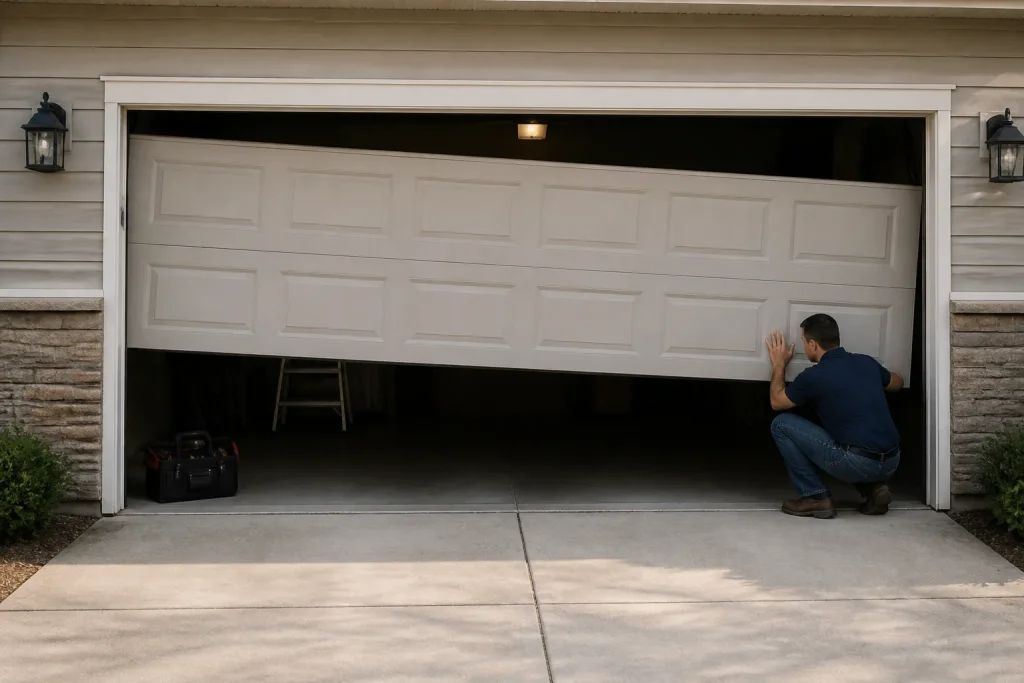
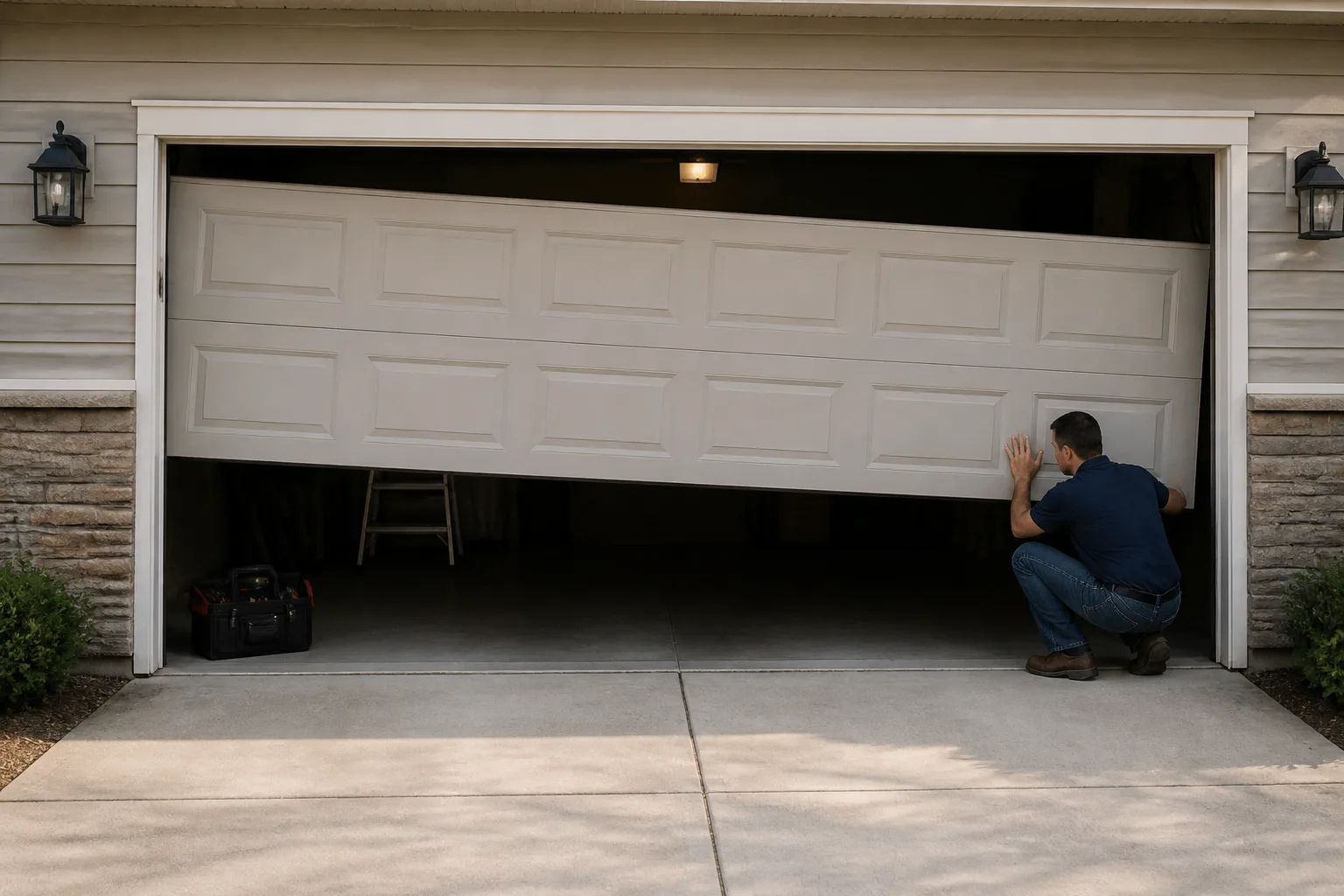
A visible gap at one top corner, when the door is fully closed, is one of the most reliable signs of uneven cable tension. One cable carries more load than the other, so the door closes slightly crooked. Left alone, the imbalance keeps pushing against the panels and the track on the tighter side, and it warps over time.
The gap is easy to spot and easy to dismiss. It looks like a sealing issue, so homeowners replace the weather seal and call it done. But if the gap keeps coming back at the same corner, the seal wasn’t the problem. Panel warping is slow and cumulative. What starts as a finger-width gap can turn into panels that no longer run true, and true panels are what keeps a door tracking straight. A bowed bottom panel on a Clopay or Amarr door is a costlier fix than the tension adjustment that would have stopped it.
One practical note: check the gap with the door closed and the opener disengaged, so the motor isn’t masking the sag. If one corner sits differently than the other on two consecutive checks, that’s a pattern, and it’s worth a professional look.
The Roller Wear Pattern That Misaligns Your Track
Worn rollers develop flat spots, and flat spots create vibration that slowly works the door out of track alignment over six to twelve months. It starts as a vibration you feel more than hear, a shudder in the door’s travel that repeats at the same spot. A roller’s round surface flattens where the weight sits, and a flat roller no longer rolls smoothly. It thumps.
Why this matters for your track: every thump nudges the door against the vertical and horizontal track. A little loosening builds up over months until one day the door catches, binds, or comes off a roller entirely. That’s when a low-cost roller replacement turns into track straightening or panel repair.
The pattern is hard to catch by ear and easy to feel through the door while it moves. If you run a hand along the door’s path and feel a repeating vibration, that’s the signal. On a Wayne Dalton door or almost any system, fresh rollers usually restore the smooth travel and the track alignment that follows it. We cover the full service spectrum, so a roller issue and any track correction that comes with it get handled in one visit, not passed to a second company.
Weatherstripping Compression as a Spring Health Clue
How evenly your bottom weather seal compresses across the width of the door is a real indicator of spring and balance health, and most homeowners never look at it. A healthy, level door presses the seal against the floor with an even contact pattern all the way across. An uneven pattern tells you the door isn’t landing level, and the springs or cables are likely the reason.
Here’s the shortcut for a Westerville homeowner. Close the door and look at the seal against the floor from inside the garage. If one side is mashed and the other is barely touching, the door is tilted, which points back to tension or spring balance. That’s a snag now, but a real problem once winter cold makes a tired seal stiff and brittle, and gaps stop sitting flat. The seal can’t fix a door that lands crooked, and replacing it won’t either.
This is the kind of read a specialist makes in a minute. We service the eight brands we handle, including Genie and Clopay systems, and know which tension issues show up where. Your exact brand, diagnosed correctly the first time, saves the trial-and-error that comes from a generalist learning your door as they go.
When to Call a Pro (and What to Leave Alone)
Call a professional for anything involving springs, cables, drums, or opener internals, and for any door that has stopped moving, come off track, or won’t stay balanced. Those components store force that can cause serious injury, and a few adjustments aren’t worth the risk. What you can safely do yourself: run the balance test, listen for where sounds come from, check the corner gaps, and feel for roller vibration. Those observations are exactly what save a technician time and save you money.
If your door’s symptoms point at the motor rather than the mechanics, that’s a different job, and we handle garage door opener repair across the top brands. If you’d rather not diagnose it at all, our team offers garage door repair and free estimates.
Related services in Westerville: beyond springs and rollers, we handle full Garage Door Repair Westerville work from new installs to diagnostics. Every call gets an upfront price before we start, so no surprise on the invoice.
The Bottom Line
Your door is telling you what’s wrong, and the early read is worth more than the repair itself. Uneven timing, a sound in one zone, a failed balance test, a stubborn corner gap, a roller thump, and an uneven seal all point at specific parts at the stage when a small adjustment beats a big bill. Catching signs early keeps a garage door spring repair from turning into a door replacement. Our technicians have up to 9 years of experience reading exactly these systems.
Garage doors are all we do, which means every tool and every part is specific to this trade. If you’re in Westerville and need help, Garage Door Repair Westerville offers free estimates. Call (855) 771-0571 and we’ll quote the job before any work starts.
Frequently Asked Questions
Most garage door repairs fall in a modest range, and the written estimate you agree to before work begins is the final price. The exact cost depends on the part and the door system, so a free estimate is the honest answer. Call (855) 771-0571 for an exact quote.
For urgent issues like a snapped spring or a door stuck open, our emergency service is a core offering, and fast dispatch runs from 7am to 7pm. For planned repairs and installs, we’ll measure and schedule a time that works. Call (855) 771-0571 and we’ll find you a slot.
No, not beyond what you agree to. We quote the job upfront, and the price you approve is the price on the invoice. If a technician finds something extra, you hear about it before any additional work begins. Call (855) 771-0571 to get started.
The local professional we connect you with is licensed and insured as Ohio requires, and our technicians have up to 9 years of experience. You’ll work with a specialist whose only trade is garage doors. Call (855) 771-0571 for a free estimate.
Written by the team at Garage Door Repair Westerville.
Need Garage Door Help?
Call Garage Door Repair Westerville - the local pro we connect you with is licensed and insured, here with fast after-hours help in Westerville.
(855) 771-0571